Our research is dedicated to the experimental investigation of aerothermodynamic phenomena in high-speed flows relevant to hypersonic flight conditions. We combine facility development, advanced diagnostics, and materials-focused experimentation to address critical challenges in hypersonic technologies, including thermal protection systems, non-equilibrium flow physics, plasma–material interactions, and high-temperature gas chemistry. Our work is supported by the Air Force (AFOSR and AFRL), NASA, the Army (ARO and ARL), and industry partners including Lockheed Martin.
Thermochemical nonequilibrium flows
We investigated the thermochemical nonequilibrium expansion through the nozzle of our arc-jet tunnel using optical emission spectroscopy and tunable laser absorption spectroscopy. Funded by the AFOSR, this work represents one of the first studies to non-intrusively characterize plasma properties directly within the nozzle of an arc-jet facility. Most thermochemical nonequilibrium kinetic models have historically been developed and validated in compressive environments, such as shock tubes, yet they are routinely applied to expanding flows with limited experimental validation.
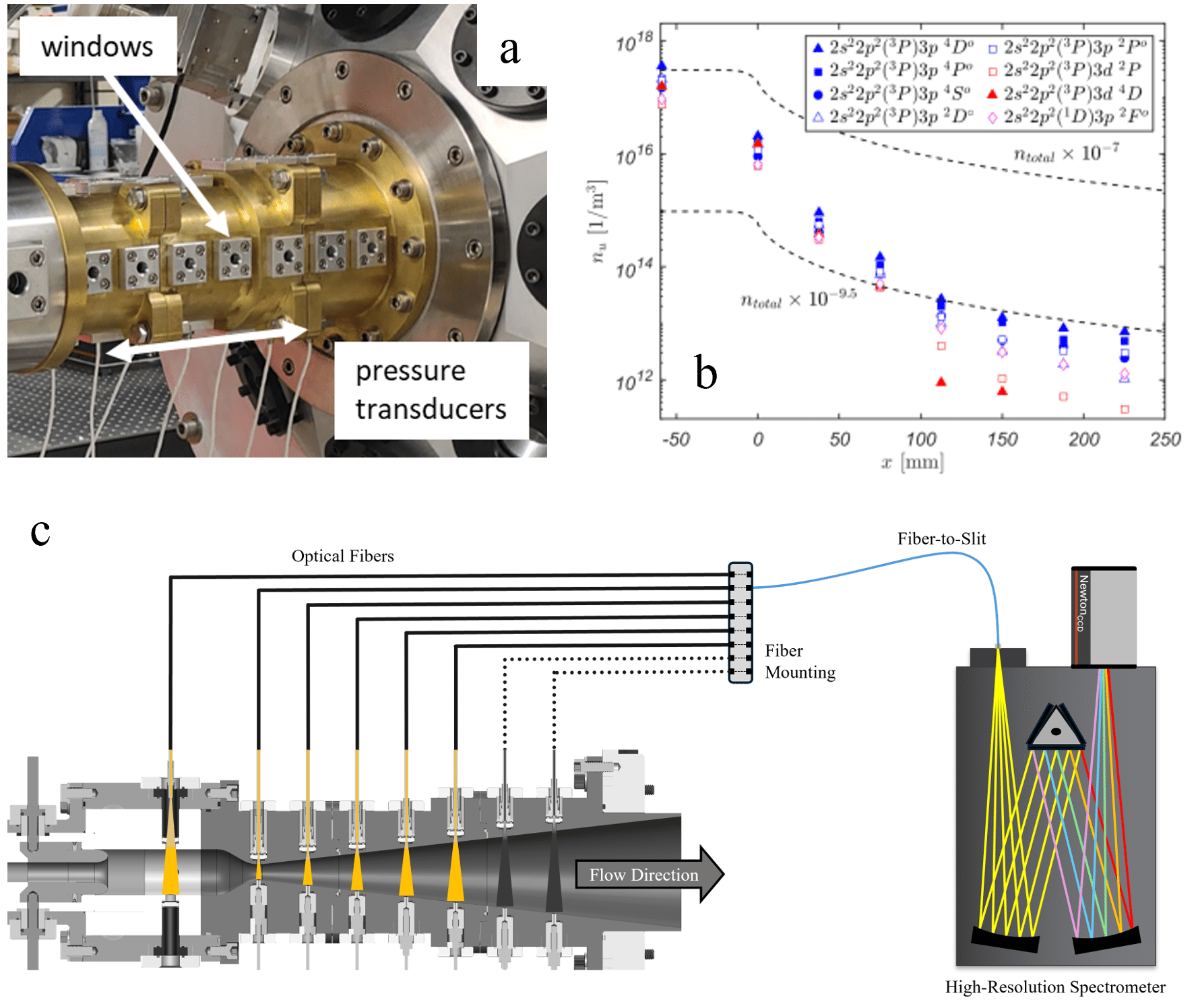
(a) Optically accessible nozzle. (b) Excited states number densities. (c) Optical emission spectroscopy setup.
To address this gap, our group determined number densities, vibrational and rotational temperatures along the nozzle through spectral fitting of the N₂ and N₂⁺ emission in the near-UV. The results of this work have been published in the AIAA Journal and Aerospace Science and Technology. This effort is being carried out with Dr. Sung Min Jo (UCF) that will perform high-fidelity numerical simulations of our experiments.
Gas-surface interaction
Our pulsed arc-jet tunnel has been employed for gas–surface interaction experiments on carbon-based materials including graphite, carbon felt, and FiberForm®. Because of the short test duration, specimens are preheated with a 3-kW continuous-wave laser prior to exposure. Initial efforts, supported by ARL and published in the AIAA Journal of Thermophysics and Heat Transfer, demonstrated the activation of surface chemistry on graphite and carbon felt under these conditions.

(a) Continuous wave laser used for preheating. (b) Experimental setup. (c) Carbon felt plasma testing. (d) Emission spectra comparison between nitrogen and air plasma.
Our objective is to exploit the enhanced quality of the pulsed flow to enable quantitative characterization of ablative phenomena through advanced non-intrusive optical diagnostics. The resulting measurements will provide datasets for the validation of surface chemistry models, particularly those describing carbon oxidation and nitridation processes under high-enthalpy conditions. In support of this effort, a 1-kHz femtosecond laser system (Coherent Astrella + Topas OPA) has been procured and is scheduled for installation in our laboratory during summer 2026.
In-situ diagnostics
This project focuses on the experimental characterization of thermal protection system (TPS) materials exposed to high-enthalpy plasma environments. Using our plasma torch facilities, our group performs screening and evaluation tests on a broad range of aerospace materials, including carbon–carbon composites, ultra-high-temperature ceramics (UHTCs), carbon phenolics, and other ablative systems relevant to atmospheric entry and hypersonic flight applications.

(a) Schematic of the optical setup. (b) Teflon sample during a test. (c) Implementation of the setup in the plasma torch. (d) Recession measurement vs time.
In parallel with materials testing, our research has emphasized the development of advanced in-situ diagnostics capable of providing time-resolved measurements of surface and subsurface material behavior during plasma exposure. Our group developed a multipoint laser transmissivity (MLT) diagnostic to measure the temporal evolution of surface recession during testing. Leveraging funds from the Army Research Office (ARO), we are also in the process of integrating an in-situ X-ray visualization system into our plasma torch facility, to enable direct observation of internal microstructural evolution during high-enthalpy exposure.
Materials screening and evaluation
The HyperMATE plasma torch serves as our primary facility for material screening and evaluation. Testing is performed on coupon-scale specimens (typically ~30 mm diameter) under high-enthalpy plasma flow conditions representative of atmospheric entry and hypersonic flight environments. Experiments are designed to assess thermal response, surface recession, oxidation behavior, structural integrity, and overall material survivability under severe aerothermal loading. These capabilities support rapid material down-selection, comparative performance assessment, and qualification-oriented testing for aerospace and hypersonic applications.
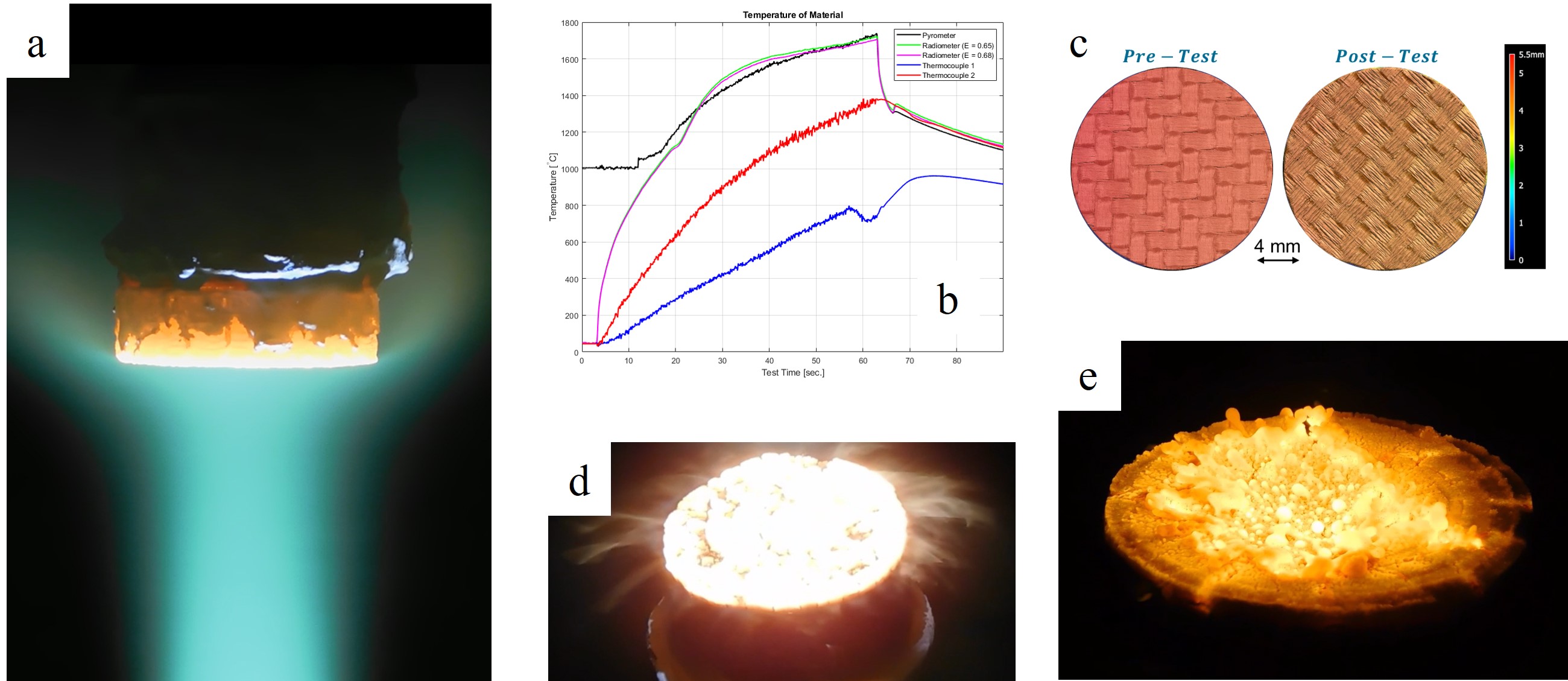
(a) Material sample tested in the HyperMATE plasma torch. (b) Temperature measurements with pyrometers and thermocouples. (c) Surface comparison before and after a test. (d) Testing of phenolic infiltrated carbon foam. (e) Testing of cenosphere-reinforced phenolic.
The HyperMATE facility is equipped with a suite of integrated diagnostic instruments for time-resolved thermal and flow characterization during testing. Surface temperature measurements are obtained using multiple two-color pyrometers covering a range from approximately 500 °C to 3000 °C, enabling reliable measurements across a broad range of material responses and emissivities. Complementary thermal diagnostics include a broadband infrared (IR) radiometer and an IR thermographic camera for spatially and temporally resolved surface heating measurements. Optical diagnostics include a near-infrared (NIR) spectrometer operating over the 900–2500 nm wavelength range for emission spectroscopy and plasma characterization, as well as schlieren imaging for visualization of flow structures, density gradients, and shock features within the plasma jet.
1-MW Arc Jet Facility
Our group is currently building a new continuous flow arc jet facility with a nominal power of 1 MW. The capabilities enabled by the new tunnel directly address a persistent gap between shorter-duration, small-scale university facilities and large national-scale arc jet wind tunnels, significantly expanding the range of accessible test conditions for hypersonic research. In particular, the new tunnel will allow high-fidelity aerothermal characterization, advanced diagnostic development, and testing of high-temperature materials in conditions near planetary entry enthalpies.
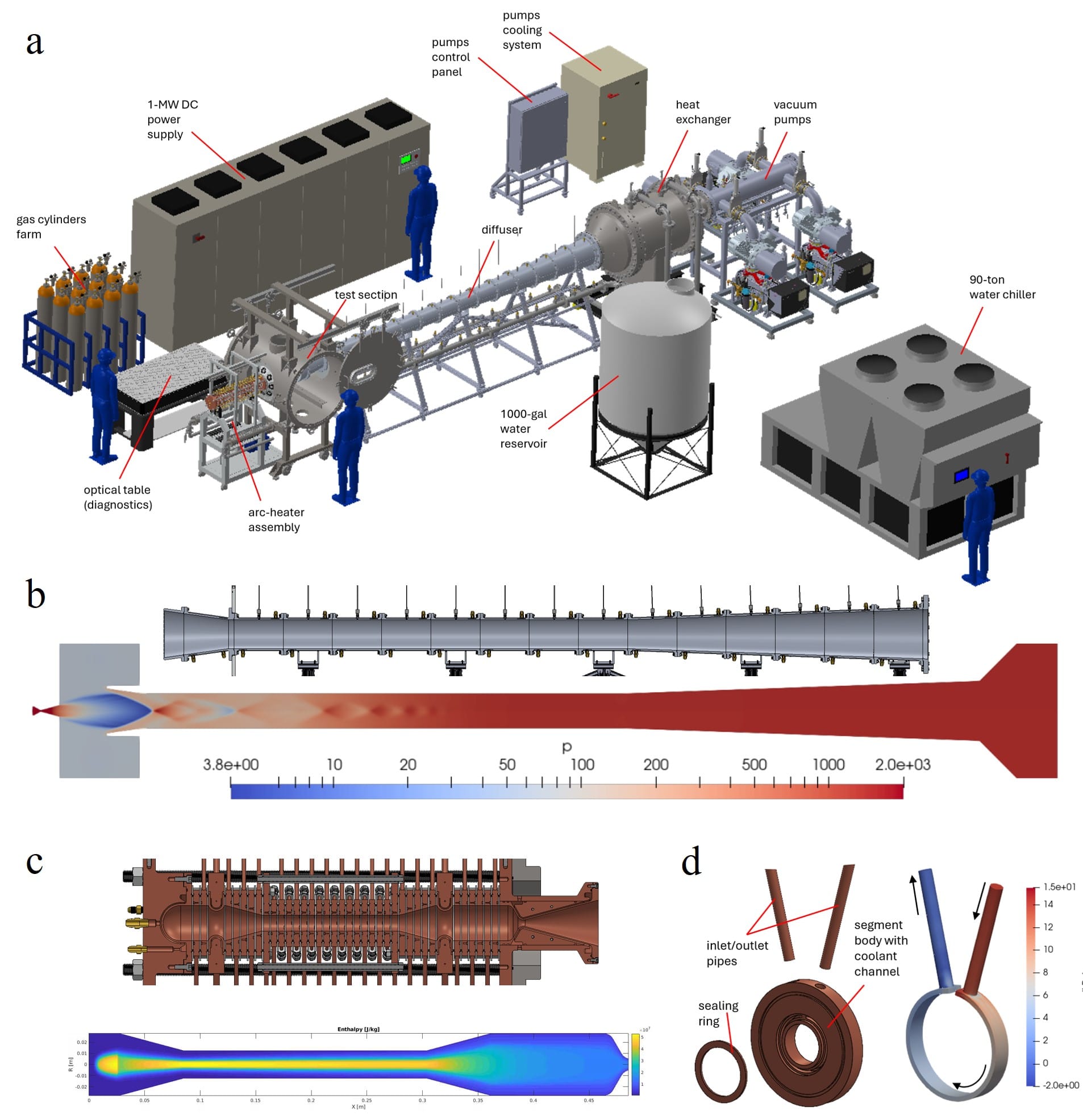
(a) Overview of the new 1-MW arc jet facility. (b) CFD analysis of the diffuser flow. (c) Simulation of the segmented arc-heater flow. (d) Thermal analysis of the copper segments.
Construction of the tunnel began in 2023 with a DURIP award from the Army Research Office (ARO) and is continuing as part of a $17.8M effort supported by the Air Force Research Laboratory (AFRL), led by the University of Tennessee Space Institute (UTSI). The design of the new tunnel has been carried out entirely within our group, and progress has been presented at the AIAA SciTech 2025 and Aviation 2026 Forums. Construction of the tunnel is expected to be completed before the end of 2026.